
How to Prepare Artwork for a Professional Vehicle Wrap
A vehicle wrap is only as good as the file it was printed from. Wrap shops see it constantly: a business owner with a great brand shows up with a logo screenshotted from Facebook, and suddenly the project is stuck rebuilding artwork instead of printing it.
If you are a Winchester business owner planning a wrap for a van, truck, or trailer, an hour spent organizing your artwork saves days on the timeline and noticeably sharpens the finished product. Here is exactly what your wrap shop hopes you will bring to the first meeting.
What files do you need for a professional vehicle wrap?
Bring your logo as a vector file, the formats usually end in .ai, .eps, .svg, or vector .pdf, along with your exact brand colors and any photos at the highest resolution you have. Vector art scales from a business card to a box truck with perfectly crisp edges, while a small web image turns blurry when enlarged. If vector files do not exist, your shop can rebuild the logo, it just adds time and cost to the front of the project.
Not sure what you have? Send whatever files exist and let the production team sort them. A good shop would rather see everything than have you guess wrong.
Start with vector art, not screenshots
The difference between vector and raster art decides how your brand looks at truck scale. Raster images, like .jpg and .png files, are made of pixels, and a logo that looks fine at website size falls apart when stretched across a tailgate. Vector art is math instead of pixels, so it enlarges infinitely with zero quality loss. Your original designer almost certainly created a vector version, and a quick email usually retrieves it.
Fonts hide a second trap. If your artwork uses a font the print shop does not own, the file can open with substituted lettering that quietly changes your branding. Ask your designer to convert text to outlines before sending, which locks the letterforms in place. Photos are the exception to the vector rule: they should simply be as high resolution as possible, straight from the camera rather than compressed through email or texting.
Design for a moving vehicle, not a flat page
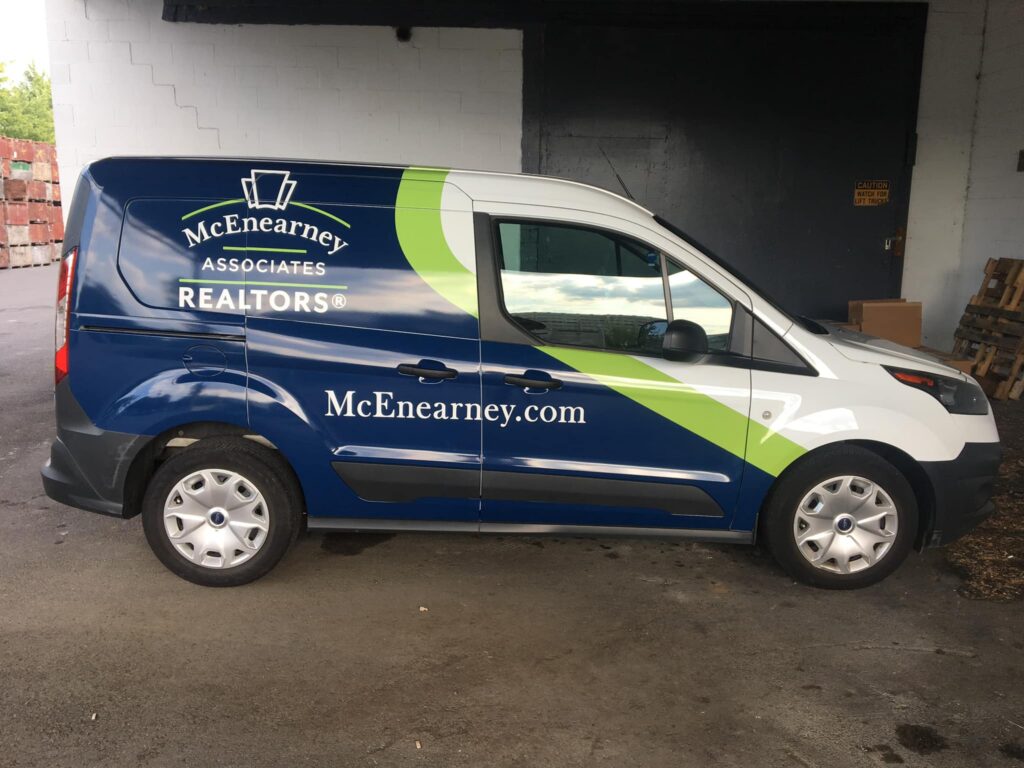
A wrap is read in traffic, which changes every design rule. The message must land in about three seconds: business name, what you do, and one way to contact you. That is the whole test. Designs that try to list every service become visual noise on Valley Avenue, while the vans people remember keep it bold and simple with generous contrast between text and background.
Physical geometry matters just as much. Door handles, body lines, rivets, windows, and curves all interrupt artwork, so professional shops design on scaled templates of your exact vehicle model to keep phone numbers off door seams and faces off gas caps. Expect key text to sit in large, flat panels of the vehicle, and trust the shop when they nudge elements away from trouble zones.
Know the specs your shop will ask about
A few production details come up on every project, and knowing them makes you a fast client to work with. Print files are typically built at a reduced scale with high resolution, and your shop handles that math. Colors should be specified in Pantone or CMYK values rather than what looks right on your phone screen, because screens display color in RGB and printers do not. If your trucks must match your storefront sign and business cards, exact color values are what make that happen.
Bleed and safe zones matter too: artwork extends past panel edges so nothing critical gets trimmed at a body line. You do not need to master any of this, only to expect questions about it and to loop in whoever controls your brand files early.
Proofs: the last exit before printing
Before anything prints, you will receive a digital proof showing the design mapped onto your vehicle from multiple angles. Read it like a contract. Check the phone number digit by digit, the website spelling, license numbers if your trade requires them, and how the design flows across doors and seams. Printing from an approved proof with a typo in it is a mistake that gets rewrapped at the owner’s expense.
Ask to see the proof at full detail on a real computer screen rather than a phone, and get a second set of eyes from someone at your company. One five minute review meeting catches what four one word text replies never will.
Bottom Line
Great wrap artwork comes down to vector logos, exact brand colors, high resolution photos, and a message simple enough to read in three seconds of traffic. Bring those, review your proof carefully, and your wrap will look sharp from every angle for years. If your art files are a mystery, bring what you have to Winchester Signs & Vehicle Wraps and the design team will get your brand road ready.
Related reading: our signs vehicle wraps services, How Much Does a Vehicle Wrap Cost in Winchester VA


